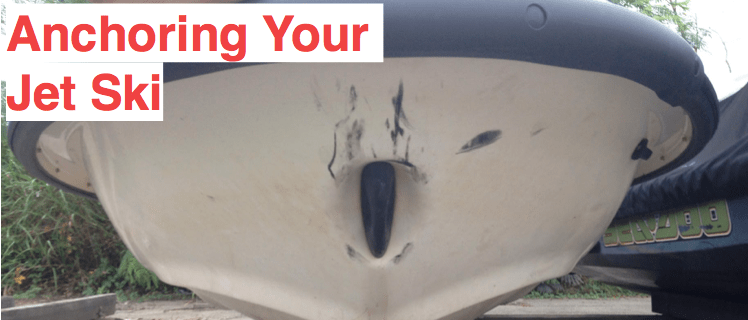
Anchoring a personal watercraft sounds simple until the first time your PWC slowly drifts away while you’re trying to relax on the beach.
I have seen it happen more than once. Someone hops off their machine, walks up the sand to grab a drink, turns around, and the ski is already floating ten feet farther out than expected. It usually starts with a small mistake like not enough rope, the wrong type of anchor, or trusting something that only works in perfect conditions.
A jet ski only weighs around 600 to 900 pounds depending on the model, but wind and current can create surprising force on a floating craft. If the anchor setup is wrong, that PWC becomes a sail.
Once you understand a few basics and choose the right gear, keeping your watercraft exactly where you left it becomes very easy.
Types of Anchors That Work Well for Personal Watercraft
Not every anchor designed for boats works well for a small PWC with limited storage. Jet ski riders need something compact, effective, and easy to handle from the seat.
These are the four styles that actually make sense.
Sandbag Anchors
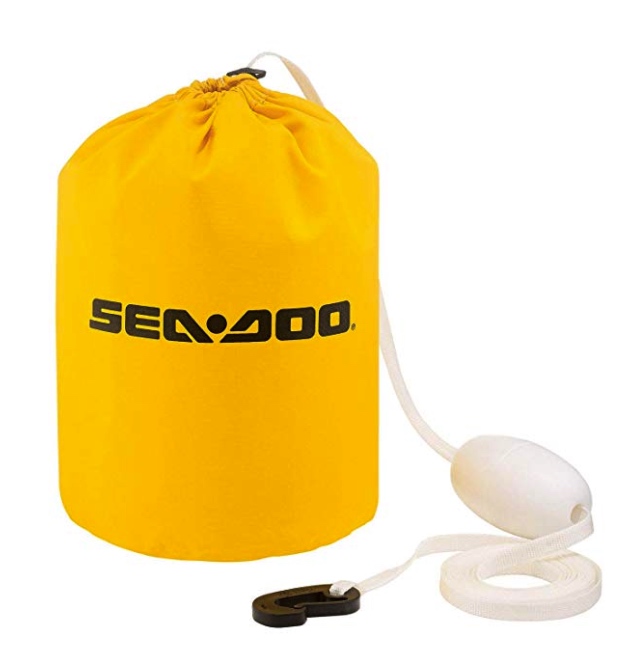
The sandbag style is probably the most common option riders carry.
The idea is simple. The bag itself weighs almost nothing while riding, then once you reach the beach you fill it with sand or rocks and drop it overboard.
This design works well because it takes almost no storage space and it will not bounce around in the front compartment the way a metal anchor can.
In calm coves it works surprisingly well. If the water is still and there are no heavy waves pushing the craft around, the weight of the sand holds the ski in place without any issues.
Where it struggles is in busy areas. Boat wakes and constant wave action can drag the bag slowly across the bottom. When that happens your ski can creep away from shore without you realizing it.
I often recommend riders treat sandbags as a convenience anchor rather than their only one.
Fluke Anchors
The classic fluke design is the one most people picture when they think of anchors.
Two wide arms dig into sand or mud and create holding power once tension is applied to the rope.
This type works well in sandy or muddy bottoms, once the flukes dig in, it holds firmly. It’s less effective on rocky or gravelly surfaces where the flukes can’t bite in cleanly. Fluke anchors also require a short length of chain between the anchor and rope, plus more overall line than other anchor styles, which can chew through your limited PWC storage space faster than you’d expect.
If you’re anchoring in sandy bottoms, this design can hold extremely well for its size.
Folding Grapnel Anchors
The folding grapnel anchor deserves more attention than it typically gets in PWC circles.
It looks like a small grappling hook with three or four arms that fold flat when not in use. That collapsible design is the main reason it works so well for personal watercraft, it stores flat, takes up almost no space, and has no awkward shape to work around.
Where grapnel anchors really stand out is versatility. Unlike a fluke anchor that needs sandy or muddy bottom to set properly, grapnel arms can hook into rocky surfaces, grab onto gravel, and still hold reasonably well in sand. That makes it a practical option if you ride in areas where the bottom type changes.
The tradeoff is holding power. In soft sand or mud, a grapnel does not dig in as deeply as a dedicated fluke, so in rough conditions or strong current it may not be your best choice.
One thing to watch: grapnel anchors can get stubborn when they hook onto rocks or debris. Attaching a short trip line to the anchor end and running it to a small float on the surface gives you a way to pull it free from above if it gets stuck.
For a rider who wants one compact metal anchor that handles multiple bottom types, the folding grapnel is worth serious consideration.
The Anchor I Personally Use Most
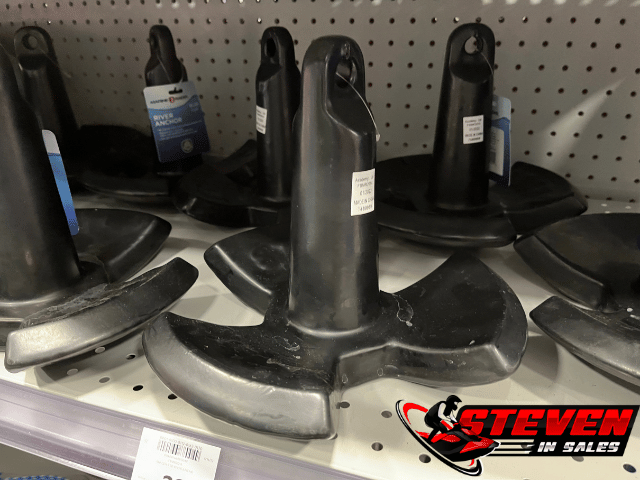
For most casual riding situations, the mushroom design is hard to beat.
It looks exactly like the name suggests. A heavy rounded head that relies mostly on weight rather than digging into the bottom.
The simplicity is what makes it attractive for personal watercraft.
An 8 to 10 pound model usually works well for most skis. Many Sea-Doo, Yamaha, and Kawasaki models fall between 700 and 900 pounds dry weight, so that amount of anchor weight is enough for normal conditions.
I tend to lean toward the 10 pound version. It gives a little extra holding power without being too bulky to store.
One trick I learned early is to wrap the anchor in a towel before putting it in the storage compartment. Even vinyl-coated anchors can scuff inner parts of the craft over time if they bounce around during rough riding.
Screw Anchors for Shore Stops
A screw anchor is one of those things that seems unnecessary until the day you need it.
Instead of dropping something into the water, you twist the metal spike directly into the sand on shore. A loop, handlebars, or hook at the top gives you a place to tie the rope.
This is one of the most secure ways to leave your jet ski unattended.
I have watched people struggle with drifting skis while someone with a screw anchor simply ties off and walks away without a second thought.
It is especially useful if you’re stopping for lunch or planning to spend a while on the beach.
The only limitation is the ground. Hard packed clay or rocky shorelines can make it difficult to screw in.
The Setup Most Riders Eventually End Up With
If you talk to riders who spend a lot of time on the water, many eventually carry more than one option.
It sounds excessive at first, but every riding location is different.
Some days the water is perfectly calm and a simple weight works fine. Other times wind or boat traffic creates enough movement that you want something stronger.
A common combination is:
- A sandbag for quick stops
- A mushroom anchor for calm water
- A screw anchor for beach tie-offs
The sandbag bag itself can even be used to store the other anchors. That keeps everything contained and prevents metal pieces from knocking around inside the storage compartment.
If someone forced me to pick only one, the screw anchor would probably be the most versatile.
You can almost always find sand soft enough near the shoreline to twist it in.
How Much Rope Do You Actually Need?
This is where many people accidentally cause their anchor to fail.
The rope length matters more than the anchor type.
Anchors hold best when the rope pulls horizontally across the bottom instead of lifting upward. That is why boaters use what is called a scope ratio.
For calm water the typical recommendation is 5:1.
That means if the water depth is 5 feet, you should use about 25 feet of rope.
If conditions are rough, many boaters increase that to 7:1 or even 10:1 to maintain a low pull angle.
This math is not random. It comes from the geometry of the anchor line angle. A longer rope reduces the vertical lift force dramatically and allows the anchor to stay buried or weighted on the bottom.
A 3/8 inch rope works well for most personal watercraft. It is thick enough to grip easily and doubles nicely as a tow rope if someone in your riding group breaks down.
For reference, a typical 3/8 inch nylon rope has a breaking strength around 4,000 pounds, which is far more than a jet ski will ever put on it in normal conditions.
Source: https://www.boatus.org/findings/18
The Mistake People Make With “Homemade Anchors”
I have seen riders throw all kinds of random objects into the water hoping they will hold.
Old kettlebells, workout plates, cinder blocks, even scrap metal.
Technically these can work for a short time, but they rarely last long in water. Most are untreated steel and begin rusting quickly. Once corrosion sets in, the metal can weaken and eventually fall apart.
They are also awkward shapes that do not store well inside a small watercraft compartment.
Purpose-built anchors are coated, balanced, and designed to hold better with less weight.
Sometimes the cheap solution actually ends up being the less reliable one.
Beaching Instead of Anchoring
Sometimes the easiest option is simply sliding the watercraft onto shore.
This works well on soft sand beaches but can damage the hull on rocky areas.
The bottom of most personal watercraft is fiberglass or reinforced plastic, and while it is strong, constant abrasion can eventually wear through.
That is why some riders install keel protectors.
These strips attach to the centerline of the hull and absorb the scraping that occurs when pulling up onto shore.
Most PWCs measure between 11 and 13 feet long, so a keel protector around 3 to 4 feet typically covers the section that actually contacts the beach.
It is one of those upgrades people rarely think about until after the first few scratches appear. Just be warned, it can create drag and slow your top speed down.
What Actually Keeps Your Ski From Drifting
Anchoring a personal watercraft is less about buying the perfect anchor and more about understanding the system.
The type of anchor matters, but so does the rope length, bottom conditions, and how exposed the area is to waves.
Most riders eventually find that carrying two or three compact options gives them the flexibility to handle almost any situation on the water.
Once you dial in your setup, anchoring becomes something you barely think about. You pull up, drop the line, and know your ski will still be exactly where you left it when you get back.

Cooper anchor is light weight and works great. A vinyl coated grapnel anchor is space efficient and perfect for anchoring in 3-6 feet of water.